Decades of South Florida Sun Leave Damage No Topical Product Reverses. Laser Does.
Decades of South Florida sun produce skin damage that no topical product reverses. Medical laser addresses it at the structural level. Here is how it works and what to expect.
Elena Gorbunova
PA-C, Beauty Medica
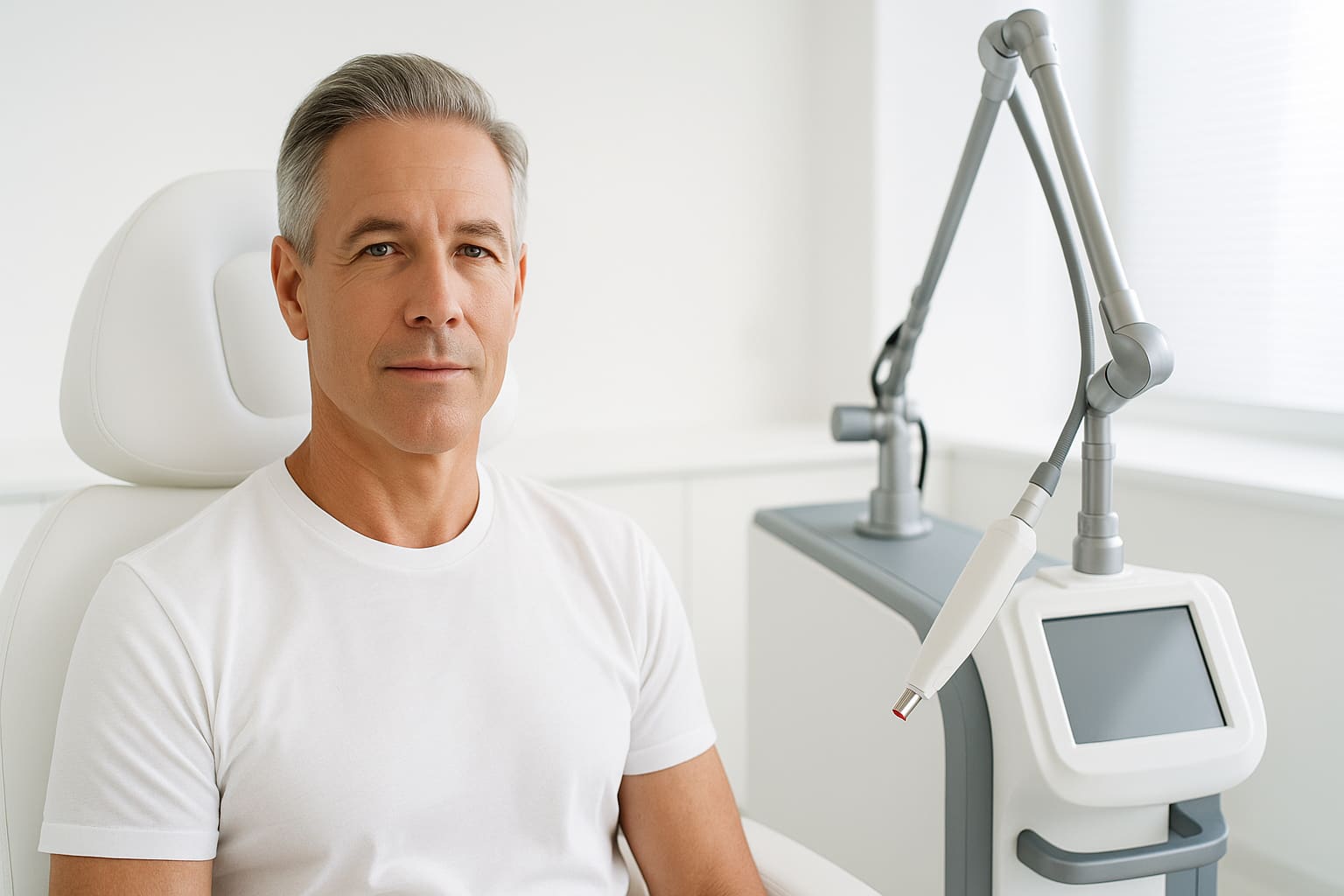
- Fractional laser treatments work by creating controlled zones of energy in the skin that trigger collagen production and cellular renewal.
- Non-ablative fractional laser is the right starting point for most men: meaningful results, no removed skin surface, and redness that resolves in 24 to 48 hours.
- South Florida UV exposure accelerates skin damage significantly. By the mid-50s, the accumulation is visible in texture, pigmentation, and surface quality.
- Laser treats what no topical product addresses: collagen degradation, sun-induced pigmentation, and texture changes at the cellular level.
What the sun actually does over 50 years
Men in South Florida accumulate UV damage at a rate most people underestimate.
The EPA classifies South Florida’s UV Index as consistently high to extreme year-round. UV exposure at those levels does not just cause sunburns. It degrades collagen, the protein that gives skin its structure and firmness. It triggers abnormal melanin production, creating uneven pigmentation. It accelerates the natural thinning of the dermis.
Most of this happens gradually and invisibly. At 35, it is not particularly visible. By 50 or 55, the accumulation is significant enough to show in texture, tone, and surface quality in ways that make a man look older than his face structure would otherwise suggest.
No topical skincare product reverses this. Moisturizers, retinols, and SPF all have a role in maintenance and prevention. None of them repair collagen that has already been degraded or address pigmentation that has already formed.
That requires a different category of treatment.
No topical skincare product reverses this.
What medical laser actually does
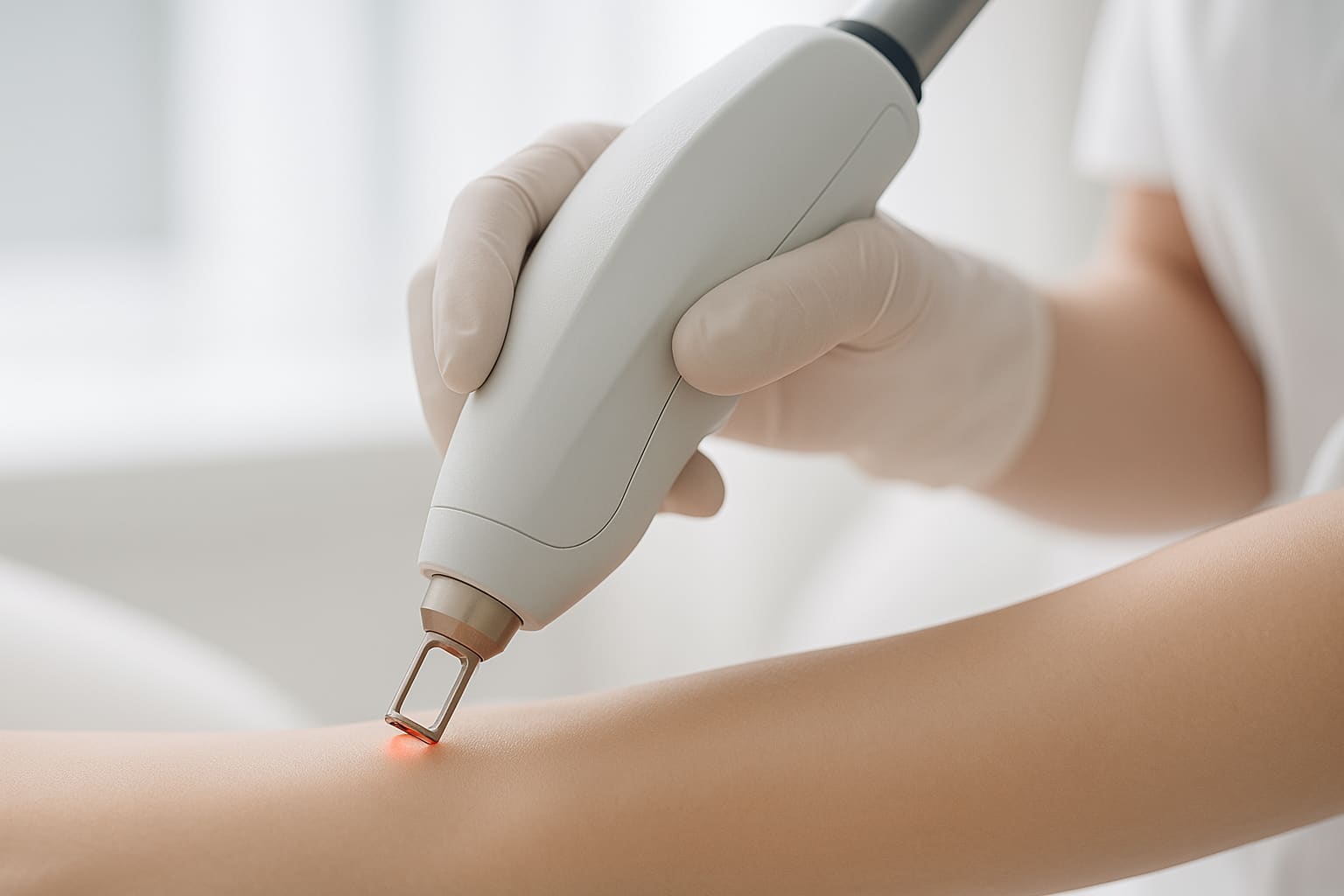
Medical laser treatments work by delivering controlled energy into the skin. The energy creates a targeted biological response: damaged tissue is cleared, collagen production is stimulated, and cellular renewal accelerates.
The key concept in modern skin laser treatment is fractional photothermolysis — a technique that treats only a fraction of the skin’s surface in each session, leaving surrounding tissue intact. Peer-reviewed reviews in Dermatologic Surgery confirm that this approach achieves meaningful improvement in photoaging, pigmentation, and texture while keeping downtime significantly lower than older full-surface resurfacing methods.
The result is a treatment that works at the level where sun damage actually lives, in the dermis and epidermis, not on the surface.
The spectrum of laser options
Not all laser treatments are equivalent. The right choice depends on how significant the damage is, what specific concerns need addressing, and how much downtime is acceptable.
Non-ablative fractional laser passes energy through the skin surface without removing it. This is the right starting point for most men dealing with South Florida sun damage, early texture changes, and mild to moderate pigmentation. Results build progressively across a series of sessions. Redness resolves in 24 to 48 hours. There is no surface wound to manage.
Ablative fractional laser (Fraxel, CO2) removes microscopic columns of skin tissue along with the surrounding tissue it treats. The results are more significant after fewer sessions, but recovery is more involved — five to seven days of visible healing for fractional CO2, longer for full-field ablative resurfacing. This category is appropriate for more significant textural damage, deeper lines, or scarring that non-ablative treatment does not fully address.
For most men starting a skin program, non-ablative fractional laser is the right entry point. A clinical assessment determines whether a more aggressive approach is warranted.
What it treats for men specifically
Men in their 50s most commonly present with three overlapping skin concerns that fractional laser addresses directly:
Accumulated sun damage. Brown spots, uneven tone, the subtle sallowness that comes from decades of outdoor exposure. Fractional laser stimulates cellular turnover and disperses superficial pigmentation progressively across a treatment series.
Texture and pore quality. Rough texture, enlarged pores, and the surface coarseness that comes from years of outdoor exposure and daily shaving. Collagen stimulation from fractional laser improves these progressively. Most men notice this change as the most visible improvement in how the face reads overall.
Early to moderate aging. Fine lines, loss of skin luminosity, and the general dullness that sets in through the 40s and 50s. Cellular renewal from laser treatment addresses these at a level topical products cannot reach.
What to expect from treatment
Before your first session: A proper skin evaluation using Fitzpatrick classification determines the right device settings for your skin tone. Parameters are calibrated to your skin. The same energy level used on lighter skin is not appropriate for darker skin tones, and a provider who applies a standard protocol regardless of skin type is not using the equipment responsibly.
During treatment: A topical numbing cream is applied 20 to 30 minutes before the session. The handpiece passes across the treatment area in measured passes. The sensation is warm and slightly prickly. Sessions take 30 to 45 minutes.
After treatment: Mild redness and warmth for 24 to 48 hours, similar to a moderate sunburn. Some men notice a subtle texture change, often described as a fine sandpaper feel, while the micro-zones resolve. After that window, the skin looks better and continues improving over the following weeks as collagen synthesis progresses.
How many sessions: Most men doing a non-ablative fractional series need four to six sessions spaced three to four weeks apart. Results build cumulatively with each session. With ablative fractional laser, one to two sessions achieve more significant improvement with a longer recovery period per session.
Where laser fits in a broader plan
Laser addresses skin quality. It does not address structural concerns like volume loss, loss of jawline definition, or muscle-driven lines. Those require neurotoxin and structural filler.
The right sequence for most men is: structural work first if it is needed, then skin quality treatment to optimize the surface over the structural improvement. Laser results look better on a face with adequate underlying structure. And a structurally addressed face looks better when the skin quality is clean and even.
A skin assessment identifies where you are on that spectrum and what the priority order should be.
Safe across skin tones
Fractional laser requires careful calibration for men with darker skin tones (Fitzpatrick IV through VI). At conservative settings, non-ablative fractional treatments are appropriate for most skin tones and carry a significantly lower risk of post-inflammatory hyperpigmentation than aggressive resurfacing.
If your skin tone falls into a range where a different protocol would serve you better, that determination is made at your consultation, not after you’ve already had a session.
- Tierney EP, Kouba DJ, Hanke CW. Review of fractional photothermolysis: treatment indications and efficacy. Dermatol Surg. 2009
- Graber EM, Tanzi EL, Alster TS. Side effects and complications of fractional laser photothermolysis. Dermatol Surg. 2008
- U.S. Environmental Protection Agency: UV Index and Skin Safety
- American Academy of Dermatology: Skin cancer facts and prevention
Elena Gorbunova
PA-C, Beauty Medica
PA-C, Beauty Medica
Related articles
Continue with another article from this section.
GLP-1 Face, Weight Loss, and Skin Quality: How to Support the Face Without Overfilling
A Beauty Medica guide to GLP-1 face, facial volume loss after weight loss, skin quality, Gouri, skin boosters, fillers, and conservative treatment …
Read article
Why Aesthetic Results Depend on Shared Vision, Not Just Products
Why credentials matter for safety, but artistry, listening, proportion, and shared aesthetic vision shape the final result.
Read article
Skin Boosters and Exosomes: What They Are, What They Are Not, and What to Ask First
A practical Skin Quality guide to skin boosters, exosomes, Gouri, Profhilo-style searches, hydration injections, texture, crepey skin, and …
Read article