The Jaw and Neck Are Where Men Show Age First. Both Are Treatable.
The jawline and neck are where men often notice the first significant signs of age. The reasons are structural, not superficial, and they respond to specific treatments when the diagnosis is accurate.
Elena Gorbunova
PA-C, Beauty Medica

- The cervicomental angle, the angle between the neck and the jaw, is one of the most visible markers of age in men and one of the most treatable.
- Platysma bands — the visible vertical cords on the neck — are a muscle structure, not a skin problem. Neurotoxin addresses them directly.
- Jawline softening after 50 is driven by mandibular bone resorption and fat pad descent, not just skin laxity. Structural filler placed at the correct depth restores definition.
- These two areas are often treated together because the visual result of one affects how the other reads.
Where men look old first
Ask men in their 50s and 60s where they notice aging most, and two answers come up consistently: the jaw and the neck.
Not wrinkles. Not lines on the forehead. The jaw, which used to be defined, has softened. The neck, which used to be clean and sharp, now has visible bands or a loss of the crisp angle under the chin.
These are not superficial concerns. The jaw and neck change for specific anatomical reasons after 50. Understanding those reasons is the starting point for any treatment that actually addresses them.
The cervicomental angle
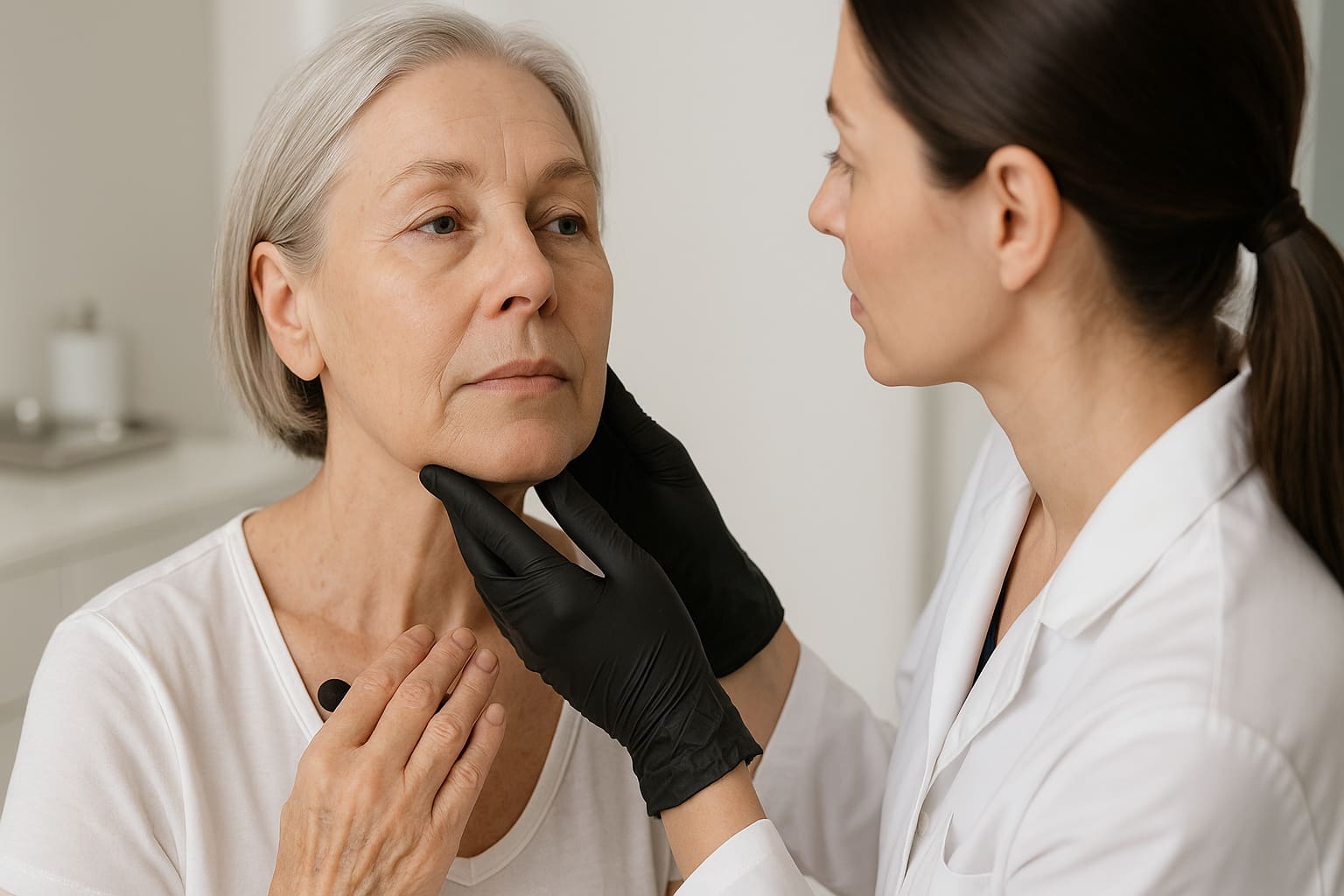
The cervicomental angle is the angle formed between the underside of the jaw and the front of the neck. In a younger face, this angle is relatively sharp and defined. The transition from jaw to neck is clear.
As men age, several things soften this angle. Submental fat increases or redistributes. The platysma muscle changes. The skin loses elasticity. And the underlying skeletal structure changes in ways that affect how the overlying tissue sits.
The result is a neck that looks heavier, a jawline that looks less defined, and a profile that reads as older than the frontal view would suggest. In many men, the neck and jaw combination is the single most age-advancing area of the face.
It is also one of the most responsive areas to targeted treatment.
Platysma bands: the muscle problem
The platysma is a thin, broad muscle that runs from the lower jaw down into the chest. In younger men, it lies relatively flat and does not create obvious surface structure.
With age, the platysma can change in two ways. It loosens and creates surface laxity. And in some men, the muscle develops visible vertical bands — the cords that run down the front of the neck and become more prominent with expression or tension.
These platysma bands are a muscle phenomenon, not a skin problem. This distinction matters because the treatment that addresses them is neurotoxin, not skin-based procedures.
Botulinum toxin injected into the platysma temporarily reduces the muscle’s ability to contract forcefully. The bands become less prominent. The neck surface smooths. The effect is meaningful and well-documented in the functional anatomy literature on lower face rejuvenation.
The treatment is not permanent. Most men maintain the result with sessions every four to six months, typically timed alongside their regular neurotoxin maintenance.
The jawline: why it softens
A sharp jawline is partly structural and partly compositional.
The structural component is the mandible itself. Published research on facial bone resorption confirms that the mandible changes measurably with age — the angle of the jaw rotates, the bone loses height, and the overall projection of the lower face diminishes. This is not a soft tissue problem and it does not respond to soft tissue treatments.
The compositional component is the fat. The jowling that appears in the 50s and 60s occurs partly because fat from the lower cheek migrates and descends, and partly because the bony support that once kept tissue in place has changed.
The result, on a man’s face, is a jaw angle that looks rounded instead of squared, a chin that appears less projected, and a lateral jaw that appears to slope downward rather than hold a defined horizontal line.
What structural filler does
Dermal filler placed at the jaw angle and along the mandibular border restores what bone loss and fat descent have removed. This is not about adding volume for fullness. It is about placing structural support at the correct anatomical depth to reestablish the architecture the face used to have.
Chin projection, similarly, responds to filler placed at the anterior chin. A modest amount of filler at the correct point changes the profile significantly. It reestablishes the cervicomental angle, improves the jaw-to-neck transition, and makes the overall lower face read as defined rather than soft.
The change, when done correctly, is not obvious as a procedure. People notice the man looks sharper, more structured, more like himself. They do not identify a treatment.
Treating jaw and neck together
The jaw and neck interact visually. A softer jaw makes the neck look heavier. A defined jaw makes the neck look cleaner. When the cervicomental angle is restored at the chin and jawline, the neck area benefits even if the neck itself is not the primary treatment site.
In practice, many men benefit from addressing both areas in the same plan. Platysma neurotoxin for the neck bands, structural filler for the jaw angle and chin. The combination produces a lower face and neck profile that is coherent and well-proportioned.
The sequence and product selection depend on the anatomy. The starting point is always a structural assessment, not a default treatment plan.
A note on what does not work here
Skin-based treatments, peels, laser resurfacing, and topical regimens, improve surface quality but do not address the structural changes described above. A man with significant jowling and platysma bands who receives only skin treatments will have better skin over an unchanged structural problem.
Similarly, no amount of exercise changes mandibular bone resorption or platysma anatomy. These are medical variables, not fitness variables.
The right treatment targets the right structure. That requires an accurate diagnosis of what has actually changed, not a general approach to looking younger.
- Mendelson B, Wong CH. Changes in the Facial Skeleton with Aging. Aesthetic Plast Surg. 2012
- Kane MA. The functional anatomy of the lower face as it applies to rejuvenation via chemodenervation. Facial Plast Surg. 2005
- Rohrich RJ, Pessa JE. The fat compartments of the face: anatomy and clinical implications. Plast Reconstr Surg. 2007
- American Society of Plastic Surgeons: Facial Aging and Rejuvenation
Elena Gorbunova
PA-C, Beauty Medica
PA-C, Beauty Medica
Related articles
Continue with another article from this section.
GLP-1 Face, Weight Loss, and Skin Quality: How to Support the Face Without Overfilling
A Beauty Medica guide to GLP-1 face, facial volume loss after weight loss, skin quality, Gouri, skin boosters, fillers, and conservative treatment …
Read article
Why Aesthetic Results Depend on Shared Vision, Not Just Products
Why credentials matter for safety, but artistry, listening, proportion, and shared aesthetic vision shape the final result.
Read article
Skin Boosters and Exosomes: What They Are, What They Are Not, and What to Ask First
A practical Skin Quality guide to skin boosters, exosomes, Gouri, Profhilo-style searches, hydration injections, texture, crepey skin, and …
Read article