Women's Facial Aging Is Not Primarily About Skin. The Four Structures That Actually Drive It.
Women's facial aging is driven by four distinct biological changes — bone, fat, collagen, and hormones — each beginning at a different stage and each requiring a different clinical response. Understanding the biology changes which treatment actually makes sense.
Elena Gorbunova
PA-C, Beauty Medica
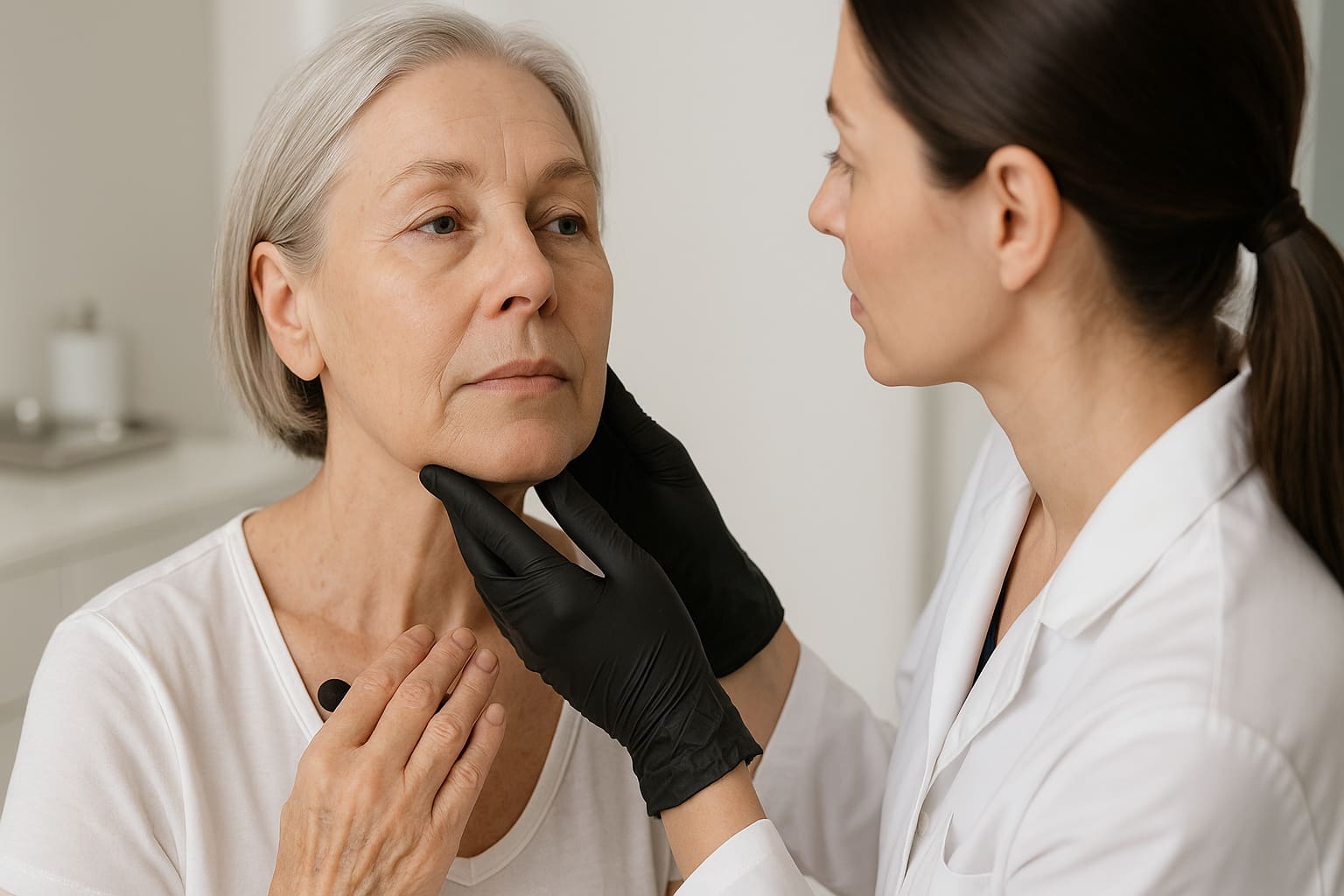
- Women's facial aging is not one process. Bone, fat, collagen, and hormones all change on different timelines.
- Hormonal change, especially around perimenopause and menopause, accelerates skin and support loss.
- The right treatment depends on which structural change is leading.
Why your face looks different
Many women assume facial aging is mostly a skin problem. Lines become more visible, texture changes, and the surface reads older, so it feels natural to think surface treatments are the whole answer. They are not.
What actually changes is deeper and more structural: bone, fat, collagen, and hormones all play distinct roles. The face changes because the support system changes.
Bone resorption: the hidden driver
The facial skeleton changes with age. The orbital rim, midface, chin, and jaw lose support in ways that alter how the overlying tissue sits. What looks like “heaviness” or “hollowing” is often partly a support problem underneath the surface.
This is one reason the under-eye area and midface can change so noticeably even when a person has taken excellent care of their skin.
Fat redistribution: why the shape changes
The face contains distinct fat compartments, and those compartments thin and shift over time. When cheek support changes, the folds below it deepen. When temporal or periorbital volume changes, the face can start reading more drawn or tired.
This is not simply a texture problem. It is often a support and structure problem.
Collagen and estrogen: the accelerated timeline
For women, hormones matter clinically. Estrogen supports collagen, hydration, and skin resilience. As estrogen declines, especially during perimenopause and menopause, the rate of visible change can accelerate.
That is why the same routine that felt sufficient in the early 40s may stop feeling sufficient in the late 40s or 50s. The biology underneath the skin has changed.
How the right treatment matches the right change
When the concern is support loss, structural treatment may need to lead. When the concern is skin quality, barrier health, or texture, skin-focused work may lead instead. Often both are part of the final plan, but not at the same time and not for the same reason.
The entire point of a good consultation is to identify which change is leading the read.
The biology is the plan
Women’s facial aging is more understandable than it feels when you first notice it. Once the drivers are clear, the treatment logic gets clearer too. That is how good aesthetic planning stays natural: it treats the real change, not just the most visible symptom.
Elena Gorbunova
PA-C, Beauty Medica
PA-C, Beauty Medica
Related articles
Continue with another article from this section.
GLP-1 Face, Weight Loss, and Skin Quality: How to Support the Face Without Overfilling
A Beauty Medica guide to GLP-1 face, facial volume loss after weight loss, skin quality, Gouri, skin boosters, fillers, and conservative treatment …
Read article
Why Aesthetic Results Depend on Shared Vision, Not Just Products
Why credentials matter for safety, but artistry, listening, proportion, and shared aesthetic vision shape the final result.
Read article
Skin Boosters and Exosomes: What They Are, What They Are Not, and What to Ask First
A practical Skin Quality guide to skin boosters, exosomes, Gouri, Profhilo-style searches, hydration injections, texture, crepey skin, and …
Read article